
Did you know that an incorrectly placed outdoor sign can lead to significant fines, potentially thousands of dollars, under local zoning laws and city ordinances? Choosing the right feather flags for business is more than a simple design choice; it's a technical decision that impacts your brand's reputation and your bottom line. Most business owners agree that there's nothing worse than a tattered, sun-bleached flag that makes a professional company look neglected.
This guide provides the professional framework you need to select, design, and deploy high-impact outdoor signage that actually lasts. We'll explore the importance of 110gsm weather-resistant materials, wind ratings of up to 18mph, and the specific base types required for different surfaces. You'll discover how to secure durable signage that drives footfall and maintains its vibrant color through the harshest weather conditions.
Key Takeaways
- Learn how the science of motion triggers peripheral vision to increase footfall using vertically-oriented signage.
- Identify the technical specifications for durable feather flags for business, including why 115gsm knitted polyester and glass-fibre poles are essential for longevity.
- Match the ideal flag shape and height to your specific location, from compact 2.6m indoor options to high-impact 4.5m roadside displays.
- Understand Beaufort Scale requirements and surface-specific base options to ensure your signage remains stable and safe in UK weather.
- Maximise your return on investment by avoiding common design mistakes and utilising professional artwork assistance for high-vibrancy results.
What Are Feather Flags for Business and Why Are They Effective?
Effective outdoor branding requires more than just a static sign; it demands a tool that interacts with the environment to capture attention. What Are Feather Flags for Business refers to vertically-oriented advertising silhouettes designed to maintain their shape while catching the breeze. Unlike traditional banners that may sag or become unreadable in low wind, these flags use a tensioned pole system to ensure your brand remains visible from every angle. In 2026, as digital advertising costs continue to rise, physical out-of-home (OOH) signage remains a critical investment for local business growth.
The primary reason these tools work so well is rooted in human biology. Our brains are hardwired to detect movement in our peripheral vision as a primary survival mechanism. When a flag flutters, it triggers an involuntary "look" response from passersby. This science of motion is why high-street shops and forecourts see a direct increase in footfall after deployment. Using feather flags for business provides a physical "stop" signal that digital banners on a smartphone screen simply can't match. They offer a high-impact presence with a remarkably low cost-per-impression, as the "ad space" you occupy outside your premises is essentially free once the hardware is purchased.
- Portability: Most systems can be assembled by a single person in under five minutes.
- 360-Degree Visibility: Rotating ground spikes and bases allow the flag to turn with the wind, preventing the fabric from tangling.
- Durability: Modern 115gsm knitted polyester is designed to withstand the unpredictable UK climate while maintaining vibrant colours.
The Evolution of Promotional Flags
The industry has moved away from traditional rectangular flags because they often wrap around the pole, hiding the message. The curved "feather" silhouette was engineered to solve this, using a flexible glass-fibre tip to keep the fabric taut at all times. Printing technology has also advanced; the shift toward dye-sublimation means ink is embedded into the fibres rather than sitting on the surface. This results in professional-grade colour saturation that doesn't peel or fade after a few weeks of sun exposure.
Versatility Across Industries
Different sectors utilise feather flags for business to meet specific commercial goals. Retailers use them to break the visual monotony of a crowded high street and signal that a shop is open. Automotive forecourts rely on the height and repetition of multiple flags to catch the eyes of drivers travelling at speed. For event organisers, these flags serve as essential wayfinding markers and brand dominance tools in large exhibition spaces, providing the vertical scale needed to stand out in a flat environment.
The Anatomy of a Professional Advertising Flag
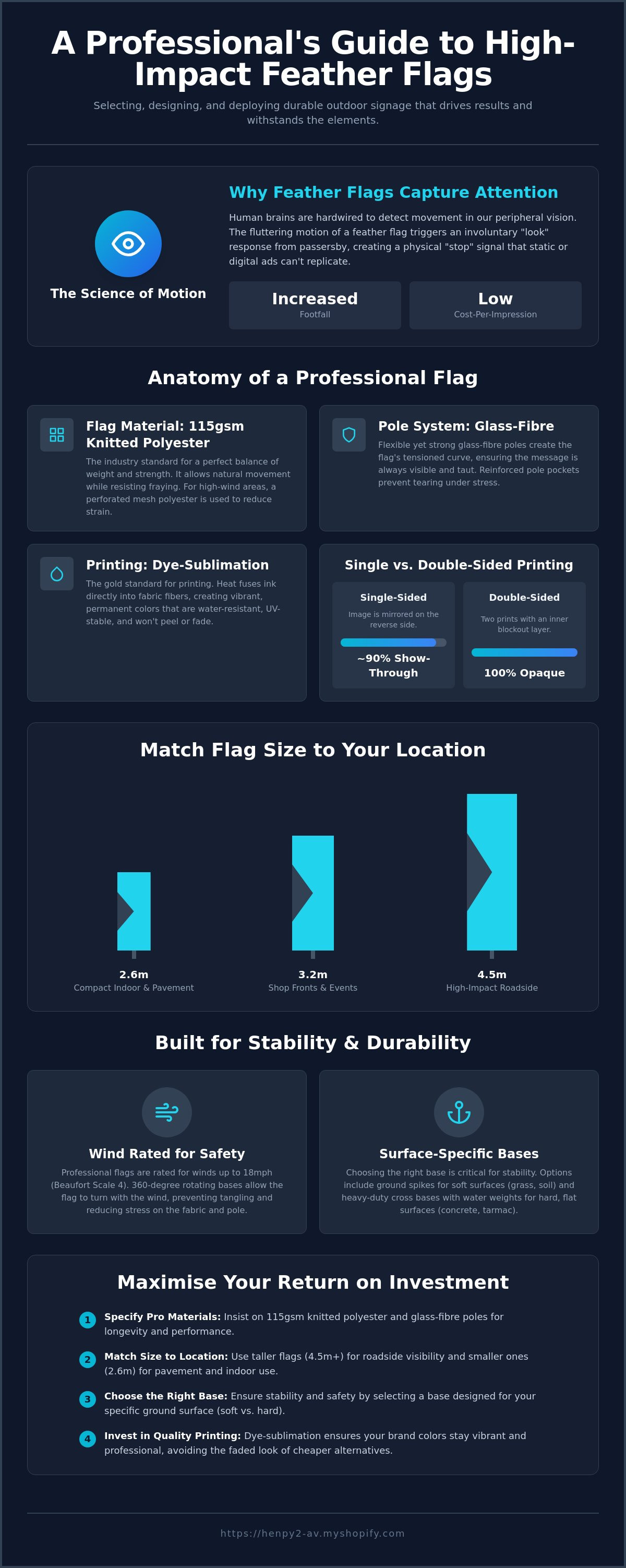
Building an effective outdoor presence requires an understanding of the technical components that prevent premature wear. While many providers offer generic options, professional feather flags for business rely on a specific combination of textile engineering and high-grade hardware. The standard material for a commercial flag is 115gsm knitted polyester. This fabric is chosen for its balance of weight and strength, allowing it to move naturally in light breezes while resisting the fraying common in cheaper alternatives. In areas with extreme wind exposure, a mesh polyester variant is often preferred; the perforated surface allows air to pass through the flag rather than pushing against it.
The visual quality of your brand depends on the printing method used. Dye-sublimation is the gold standard because it uses heat to fuse the ink directly into the fabric fibres. This creates a permanent bond that is both water-resistant and UV-stable. When choosing your layout, you'll need to decide between single-sided and double-sided printing. Single-sided flags offer approximately 90% show-through, meaning your image is visible on the reverse in a mirrored format. Double-sided flags use two separate pieces of fabric with a silver blockout layer in between, ensuring your message is perfectly legible from both directions regardless of the light source.
Understanding Flag Fabric Durability
Knitted polyester is a durable, tension-resistant fabric designed specifically for high-movement applications. To prevent the pole from piercing the top of the flag, professional designs include reinforced pole pockets made from heavy-duty elasticated webbing. These components, combined with UV inhibitors in the ink, ensure your investment survives the UK's unpredictable seasons. When considering Durability and Stability: Navigating UK Weather, it's vital to ensure your signage meets safety standards and remains structurally sound.
Hardware and Pole Systems
The pole is the backbone of your display. While aluminium poles are common, they're often too rigid and can snap under high pressure. Apex Banners uses sectional glass-fibre poles because they're flexible and return to their original shape after bending. Each system includes a tensioning loop at the base to keep the fabric taut, maintaining the flag's professional silhouette. If you're looking for commercial-grade hardware that stands the test of time, you can explore our range of durable flag kits designed for heavy business use.
Selecting the Ideal Flag Shape and Size for Your Location
Choosing the right silhouette for your branding involves more than just picking a design that looks good on a screen. It requires a strategic match between your logo's geometry and the flag's physical constraints. For most feather flags for business, the goal is to maximise the active area where your message is most legible. If your brand relies on a long horizontal logo or specific bullet points of service, the vertical edge of a standard feather shape provides the necessary canvas without cropping your content.
The "Eye-Level Rule" is a fundamental principle you shouldn't ignore when planning your outdoor signage. You must ensure that your primary message or call to action isn't lost in the lower third of the flag. As potential customers approach your premises, their gaze naturally falls on the middle and upper sections. Placing critical information too low risks it being obscured by parked cars, street furniture, or passing pedestrians. A professional layout keeps the most important brand assets at a height that remains visible even in crowded environments.
Feather Flags vs. Teardrop Flags
Feather flags are the commercial standard for brands needing to display text. Their straight vertical edge allows for a larger surface area, making them perfect for "Open" signs or company names. However, in tight urban settings, the loose bottom edge can create a flapping noise in high winds. Teardrop flags offer a high-tension alternative. The fabric is pulled tight across the frame, which eliminates noise and prevents the flag from wrapping around the pole. This shape is the superior choice for circular logos or minimalist icons that need a sleek, modern frame.
Sizing Guide for Maximum Visibility
Height is the primary factor in determining the distance from which a customer can identify your business. Selecting the wrong size can lead to your brand being overlooked or, conversely, obstructing your storefront. Consider these common applications:
- Small (approx. 2.6m): Ideal for indoor exhibitions, trade show stands, or narrow pavements where you don't want to interfere with overhead shop signs.
- Medium (approx. 3.2m): A versatile "all-rounder" for high-street storefronts that provides enough height to be seen over cars without requiring massive ground clearance.
- Extra Large (4.5m+): Essential for roadside forecourts, festivals, and large events. At this height, your brand can catch the attention of drivers travelling at 40mph or more from a significant distance.
When you're deploying feather flags for business in an open field or a large car park, the extra height of a 4.5m kit is necessary to provide the vertical scale required to stand out against the horizon. Matching the size to the speed of passing traffic ensures your message has enough "read time" to be effective.
Durability and Stability: Navigating UK Weather and Base Options
Maintaining a professional outdoor presence requires more than just high-quality printing; it demands hardware that can withstand the logistical challenges of the UK climate. The reliability of feather flags for business depends heavily on matching your equipment to the specific wind conditions and surface types of your location. While standard flag systems are typically wind-rated for speeds up to 18mph (Beaufort Scale 4), the longevity of your display is governed by how you manage these environmental stressors. Neglecting to monitor local weather patterns can lead to hardware failure or fabric damage that undermines your brand's image.
Maintenance is a practical necessity that many business owners overlook. Atmospheric pollutants, salt air, and road grit can accumulate on the polyester fibres, acting as an abrasive that weakens the material over time. Regularly washing your flags in a standard 30-degree cycle can extend their operational lifespan by several months. For businesses in coastal UK locations, rinsing the glass-fibre poles with fresh water is essential to prevent salt-induced corrosion on the rotating mechanisms, ensuring the flag continues to turn freely with the wind.
The Essential Guide to Flag Bases
Selecting the correct base is the most important factor in ensuring the stability of your signage. The wrong choice can result in your display toppling, which poses a safety risk and potential damage to the hardware. Consider these professional options:
- Ground Spikes: These are the ultimate solution for soft ground like grass or soil. They provide deep-rooted stability that resists high winds better than any portable alternative.
- Water or Sand Fillable Bases: These offer excellent portability for car parks and forecourts. Once filled, they provide the heavy ballast required to keep large 4.5m flags upright on hard surfaces.
- Cross Bases and Weight Bags: Best suited for indoor exhibitions or flat, sheltered outdoor areas. Adding a weighted "doughnut" bag ensures the system remains stable on concrete or tiled flooring.
Weatherproofing and Longevity
Professional-grade flags feature double-stitched hems and reinforced pockets to prevent the fabric from fraying at the edges, which is where most wear begins. You must take your flags down in winds exceeding 24mph (Gale Force 6) to prevent structural damage and ensure public safety. Beyond weather, you must also consider legal compliance. Under current UK regulations, failing to comply with local planning rules for outdoor advertisements can result in fines of up to £2,500. For example, a flag projecting from a building must not exceed two square meters without specific consent.
If you need a complete, weather-ready solution for your storefront, you can order a professional feather flag kit that includes commercial-grade hardware and a choice of stable bases.
Maximising ROI with Custom Printed Flags from Apex Banners
Securing a high return on investment for your outdoor signage requires more than just high-quality fabric; it necessitates a design that converts passing interest into tangible footfall. When deploying feather flags for business, the most common mistake is over-complicating the visual message. A flag is a high-speed communication tool. If a driver or pedestrian cannot decode your brand and offering within three seconds, the opportunity is lost. Professional branding relies on a strategic balance of colour, scale, and placement to ensure your message remains legible even when the flag is in motion.
The efficiency of your marketing campaign also depends on logistical reliability. Apex Banners specialises in meeting the high-pressure demands of commercial clients, providing fast nationwide UK delivery to ensure your signage arrives in time for critical product launches or regional trade shows. By choosing a supplier that understands the technical requirements of large-format printing, you avoid the costs associated with reprints or hardware failures. Investing in professional-grade kits from the outset ensures your brand is represented with the visual vibrancy it deserves.
Designing for Impact
High-contrast colour schemes and simple, sans-serif fonts are essential for outdoor visibility. You should always prioritise logo placement at the top of the pole, as this area remains visible even if the lower section is partially obscured by street furniture. Avoiding the "cluttered flag" mistake means focusing on one clear message, such as a company name, a specific service, or a directional arrow. If you don't have a dedicated design team, you can utilise Apex Banners' graphic design and artwork assistance to ensure your files are perfectly configured for the dye-sublimation process.
The Ordering Process and Support
Scaling your brand presence often involves more than just a single flag. For a cohesive professional look, many businesses coordinate their feather flags with other high-impact tools like PVC banners, mesh banners, or café barriers. This creates a multi-layered branding environment that reinforces your message across the entire storefront or event space. Our simple online ordering system allows you to select custom sizes and hardware configurations tailored to your specific site requirements. If you have technical queries regarding wind ratings or artwork templates, our UK-based support team provides direct, expert guidance to facilitate your project.
Ready to increase your brand's outdoor visibility with commercial-grade signage? Start your project with Apex Banners today and benefit from professional artwork support and durable hardware designed for the UK market.
Elevate Your Brand Visibility with Professional Signage
Implementing high-impact feather flags for business requires a precise balance between technical durability and strategic design. You've learned that selecting 115gsm weather-resistant materials and flexible glass-fibre poles is essential for surviving the UK climate. By applying the "Eye-Level Rule" to your artwork and matching your base hardware to the specific terrain, you ensure your signage remains both stable and effective at capturing local footfall. These technical choices transform a simple flag into a reliable marketing asset that represents your brand's professionalism.
When you're ready to upgrade your outdoor branding, Apex Banners provides the commercial-grade solutions needed for long-term success. We offer professional artwork assistance to ensure your graphics are perfectly configured for print, along with fast nationwide UK delivery to meet your campaign deadlines. Our kits are built from weather-resistant materials designed to maintain their visual vibrancy regardless of the season.
Order your custom feather flags from Apex Banners and start attracting more customers to your business today. We look forward to helping you stand out on the high street.
Frequently Asked Questions
Do I need planning permission for feather flags in the UK?
You may require planning permission depending on the size and location of your display. Under current 2026 regulations, a flag attached to a flagpole projecting from the side of a building cannot exceed two square meters without local authority consent. Non-compliance can result in a fine of up to £2,500. It's advisable to check with your local council if you plan to place signage on public land or use multiple extra-large flags.
How long do feather flags typically last outdoors?
A professional flag typically lasts between six and twelve months with continuous outdoor use. This lifespan depends heavily on local weather conditions and how often the hardware is maintained. Using high-quality 115gsm knitted polyester and taking the flags down during severe storms will significantly extend their durability. Regular washing also prevents grit from causing abrasive wear on the fabric fibres over time.
What is the difference between a feather flag and a teardrop flag?
The primary difference lies in the shape and fabric tension. Feather flags for business provide a larger vertical surface area, which is ideal for displaying long text or rectangular logos. Teardrop flags use a more rounded silhouette where the fabric is pulled tight across the frame. This tension prevents the flag from flapping in the wind, making it a quieter and more stable choice for urban environments.
Can I wash my feather flags if they get dirty?
Yes, you can wash your printed flags to remove road salt, grit, and pollutants. We recommend a standard machine wash at 30 degrees Celsius using a mild detergent. Avoid using bleach or tumble drying, as high heat can damage the polyester fibres and affect the colour vibrancy. Air drying while the flag is attached to the pole is the most effective method to prevent creases.
What wind speed can a standard feather flag withstand?
Standard flag systems are wind-rated to withstand speeds of up to 18mph, which is Beaufort Scale 4. While the glass-fibre poles are flexible, we strongly recommend taking your flags down if winds are forecast to exceed 24mph. Operating in gale-force conditions increases the risk of the fabric tearing or the base becoming unstable, which can lead to hardware damage or potential safety hazards for passersby.
Can I use my feather flag indoors at an exhibition?
You can certainly use these flags indoors by selecting a compatible base. For exhibition halls and showrooms, a cross base or a flat square base provides the necessary stability without damaging the floor. If you're using a smaller 2.6m flag, it's an excellent way to create vertical height and brand dominance within a crowded indoor event space where floor space is limited.
Do your flags come with a double-sided print option?
We offer both single-sided and double-sided printing options for our entire flag range. Single-sided flags feature a mirrored image on the reverse with approximately 90% show-through. Double-sided flags consist of two separate pieces of printed fabric with a silver blockout layer sewn in between. This ensures your branding is perfectly legible and correctly oriented from both directions, regardless of the lighting conditions.
How do I ensure my artwork is the correct resolution for a large flag?
To achieve a professional finish, you should supply your artwork in a vector format such as a high-resolution PDF, EPS, or AI file. If you're using raster images, they should be at least 150dpi at the actual print size to avoid pixelation. Apex Banners provides professional artwork assistance to check your files and ensure they are perfectly configured for large-format dye-sublimation printing before production begins.